
A blockchain is a decentralized, tamper-resistant digital ledger that records transactions across a distributed network of computers. Instead of relying on a central authority (like a bank, clearing house, or government) to verify records, the network uses cryptography and consensus rules to validate and store data.
The Shared Notebook Analogy
Imagine four friends—Alice, Bob, Charlie, and David—frequently lending each other money.
Instead of trusting a single person or a bank to keep track of their balances:
- Everyone has an identical notebook.
- Whenever Alice wants to send $10 to Bob, she announces to all four: “I am transferring $10 to Bob.”
- Each person verifies that Alice actually has $10.
- If valid, everyone writes that transaction on the current page of their notebook.
- Once a page fills up, they solve a mathematical puzzle to “seal” the page with a unique cryptographic stamp.
- The new page references the stamp of the previous page, linking them together forever.
Core Architecture: How the “Chain” Forms
Every block in a blockchain typically contains three fundamental components:
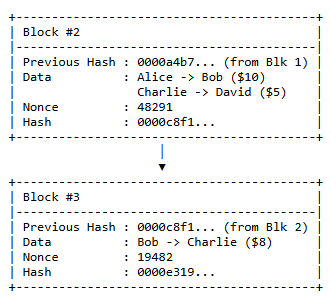
Transaction Data: The records being stored (e.g., sender, receiver, asset amount, timestamp).
- Current Hash: A cryptographic digital fingerprint (typically generated using SHA-256) calculated from all data inside the block. Even changing a single comma completely alters this hash.
- Previous Hash: The cryptographic fingerprint of the preceding block. This back-reference creates the immutable chronological chain.
Step-by-Step Transaction Flow
- Transaction Requested: Alice initiates a transfer to Bob using her digital wallet. The transaction is digitally signed using Alice’s private key to prove ownership.
- Broadcast to Network: Alice’s signed transaction is sent out to a peer-to-peer (P2P) network of computers, known as nodes.
- Mempool & Validation: Nodes independently check whether Alice has sufficient funds and whether the signature is valid. Valid pending transactions wait in a memory pool (mempool).
- Block Packaging: Special nodes (miners in Proof-of-Work, validators in Proof-of-Stake) group pending transactions into a new candidate block.
- Consensus: The network executes an agreed consensus mechanism:
- Proof of Work (PoW): Nodes expend compute power to find a mathematical input (nonce) producing a hash below a certain target threshold.
- Proof of Stake (PoS): Validators are selected deterministically or pseudo-randomly based on the volume of native tokens they have locked up as collateral.
- Chain Appended: Once consensus validates the candidate block, every node appends it to their local copy of the ledger. Bob receives the funds, and the transaction is finalized.
Why Blockchain is Tamper-Proof
| Security Feature | How It Works |
| Hash Dependency | If an attacker modifies an old transaction in Block 2, Block 2’s hash changes immediately. Because Block 3 stores the original Block 2 hash, the chain breaks at Block 3. |
| Distributed Consensus | Even if a bad actor alters all subsequent blocks on their local machine, other network nodes compare their chains. The network rejects the altered chain via consensus (e.g., the longest-valid-chain rule). |
| Asymmetric Cryptography | Public/private key pairs ensure only the legitimate owner of an asset can sign an outgoing transaction, eliminating identity spoofing without exposing private credentials. |
Setting up enterprise blockchain infrastructure
When setting up enterprise blockchain infrastructure, you are essentially building a distributed database system that must reach agreement (consensus) across untrusted environments without sacrificing security or speed.
Breakdowns of the three core technical pillars—Node Engine, Node Infrastructure, and Smart Contract Languages—detail how these components fit into the stack.
1. The Node Engine (Software Layer)
The Node Engine is the core client software running on every machine in the network. It handles peer-to-peer (P2P) networking, consensus algorithms, state management, and execution environments.
- Virtual Machine / Execution Environment:
- Executes smart contract code deterministically across all nodes.
- Examples: EVM (Ethereum Virtual Machine used in Besu/Quorum), WASM (WebAssembly used in Substrate/Polkadot), or Chaincode Runtime (Docker/Go containers used in Hyperledger Fabric).
- Consensus Engine:
- The mechanism that determines how nodes agree on the order of transactions.
- Enterprise Engines: IBFT 2.0 (Istanbul Byzantine Fault Tolerance), Raft (high speed, lower decentralization), or PoA (Proof of Authority).
- State Database:
- Every full node stores a copy of the current system state (account balances, smart contract variables).
- Key-Value Databases: Embedded databases like LevelDB or RocksDB are typically used inside the node engine to allow ultra-fast reads/writes.
2. Node Infrastructure (Hardware & DevOps Layer)
To maintain a high-availability network, you need a multi-tiered node architecture rather than running identical servers everywhere.
               [ User / Enterprise App ]
                           │
                           ▼
                  [ Load Balancer ]
                           │
          ┌────────────────┴────────────────┐
          ▼                                 ▼
   [ RPC / API Node ]              [ RPC / API Node ]  <-- Public / Read-Heavy Layer
          │                                 │
          └────────────────┬────────────────┘
                           ▼
               [ P2P Internal Network ]
                           │
          ┌────────────────┼────────────────┐
          ▼                                 ▼
   [ Validator Node ]              [ Validator Node ]  <-- Isolated / Write Layer
  (Sign Blocks/State)             (Sign Blocks/State)
Node Roles
- Validator Nodes: Participate directly in consensus (producing blocks and signing transactions). These must be strictly isolated behind firewalls with no direct public internet exposure to prevent DDoS attacks.
- RPC / API Nodes: Handle incoming read/write requests from applications, verify payload signatures, and broadcast them to validator nodes.
- Archival / Indexer Nodes: Store full historical states from block zero. Required if your application needs deep history queries (e.g., auditing historical changes from 2 years ago).
Hardware & Cloud Compute Requirements (Per Enterprise Node)
- CPU: Minimum 4-8 cores (High-throughput chains require compute-heavy signature verification).
- RAM: 16 GB to 32 GB (State caching requires high memory).
- Storage: NVMe SSDs are mandatory (standard HDD/SATA SSDs cannot keep up with high disk I/O rates during block synchronization). Storage auto-scaling is needed as the chain grows.
- Network: Dedicated 1 Gbps+ bandwidth with managed Key Vaults / Hardware Security Modules (HSMs) to protect node private keys.
3. Smart Contract Languages & Frameworks
Smart contracts are compiled programs deployed directly on-chain. Language choices depend heavily on the underlying framework.
| Language | Primary Ecosystem | Pros | Cons / Considerations |
| Solidity | Enterprise Ethereum, Hyperledger Besu, Avalanche Subnets | Massive ecosystem, rich libraries (OpenZeppelin), vast talent pool. | Susceptible to security traps (reentrancy, integer overflows if unhandled). |
| Rust | Substrate (Polkadot), Near, Solana | Extreme memory safety, high performance, compile-time security. | Steeper learning curve for conventional enterprise developers. |
| Go / Java | Hyperledger Fabric | Standard enterprise languages; developers don’t need to learn Web3 DSLs. | Lacks inherent execution guards (e.g., non-deterministic code can break consensus). |
| Daml | Canton / Enterprise Distributed Ledgers | Domain-specific language built specifically for multi-party workflows and privacy. | Specialized syntax; restricted to specific enterprise ecosystems. |
4. Enterprise Middleware & Storage Infrastructure
A blockchain node alone is inadequate for enterprise integration. You need two additional infrastructure components:
- Off-Chain Data Storage (IPFS / Cloud Buckets):
- Putting a 5MB PDF directly into a smart contract costs thousands of dollars in gas/compute resources.
- Best Practice: Store the heavy payload in AWS S3 or IPFS (InterPlanetary File System), generate a cryptographic hash (e.g., SHA-256) of the file, and store only the hash on-chain.
- Web3 Middleware & Event Indexers:
- Blockchains do not push data to applications automatically. You need middleware (like Hyperledger FireFly, The Graph, or custom WebSockets/gRPC listeners) to listen for on-chain events and update your existing ERP, CRM, or relational databases (PostgreSQL) in real time.